
To source custom polyurethane parts, start with the component’s working function and the manufacturing capability needed to reproduce it. A product photograph, a hardness value or a list of industries served can help identify candidates, but none establishes that a factory can supply your particular construction consistently.
This guide helps equipment manufacturers and engineering buyers find and technically screen a cast polyurethane supplier. It covers new components, replacement of legacy parts and qualification of a second source, with an emphasis on the evidence needed before committing to production.
Define the Project Before You Source Custom Polyurethane Parts
State whether you need a new design, a replacement for an existing component or another approved source for an established part. These projects begin with different evidence. A new design needs a functional specification; an obsolete replacement may need geometry reconstruction; an additional source needs a documented equivalence and approval plan.
| Project | Useful starting evidence | Main question |
|---|---|---|
| New equipment component | Assembly drawing, duty, mating surfaces and required function. | Can the proposed material and construction meet the design requirement? |
| Legacy replacement | Authorized drawings, identified used and unused samples, mating dimensions and failure history. | What was the intended geometry and which conditions must the replacement survive? |
| Second source | Approved baseline, acceptance methods, representative parts and existing qualification evidence. | Does the alternate supplied construction meet the same required function? |
Confirm the manufacturing route early. Our cast polyurethane versus TPU guide helps distinguish thermoset casting from thermoplastic processing. Search for the route you need rather than assuming every business offering “PU parts” uses the same process.
How to Find a Custom Polyurethane Manufacturer
Combine the process with the component and duty in your search: for example, cast polyurethane with metal inserts, custom PU wear components or an application-specific elastomer manufacturer. Build a candidate list from the actual work shown and the questions the supplier can answer, then confirm the details directly.
To source custom polyurethane parts efficiently, establish who is responsible for engineering review, manufacture and inspection. A manufacturer, distributor and engineering integrator can provide different services. What matters is a clear account of where the work is performed, how subcontracted operations are controlled and who owns the technical response.
Ask for relevant manufacturing examples that can be shared without breaching another customer’s confidentiality. Examples should address similar geometry, inserts, contact conditions or production requirements. A customer logo or attractive casting photograph is not evidence that the offered part meets your specification.
Screen the Factory Against Your Component
A cast polyurethane supplier should be able to discuss the function, propose a manufacturing route and identify missing application inputs. Share loads, movement, contact surfaces, media, temperature and the outcome that makes the part unacceptable. Use our cast polyurethane material-selection guide to prepare those inputs.
| Area | Ask the candidate | Look for |
|---|---|---|
| Formulation | How will candidate materials be selected for this duty? | A controlled material reference and relevant property or application evidence. |
| Tooling and casting | How will the geometry, release, insert position and critical surfaces be produced? | A part-specific manufacturing review with unresolved points identified. |
| Finishing and inspection | Which features are molded or finished, and how will they be measured? | Agreed methods, datums, conditions and practical tolerances. |
| Repeat manufacture | How is the approved build identified and reproduced? | Relevant batch records, revision control and change-review arrangements. |
UBE Urethane Systems describes application-dependent formulation options. That background supports candidate selection; a raw-material brand does not establish finished-part quality or prove that a particular factory uses the system.
Ask which processing and post-cure requirements apply to the selected formulation, rather than imposing a universal recipe. A factory’s oven setting is a manufacturing parameter, not a service-temperature rating. Likewise, claimed precision should be related to your grade, geometry, process and inspection conditions.
Compare chemical systems without assigning a universal lifetime
Polyester, polyether and other system descriptions help organize the material discussion; they are not finished-part specifications. Ask for evidence under the actual oil, water, cleaning and temperature exposure. Do not assign every polyester PU a shelf or service life below one year, or assume every polyether grade meets the same wet or cold duty.
Review surface defects and internal condition by function
Define permitted surface condition by location, size and effect on the component. A void at a stressed edge, sealing face or bond interface may matter differently from a minor cosmetic feature. Photographs alone cannot establish internal soundness or prove that a bubble is harmless. Agree relevant inspection and, where justified, destructive sample examination before production approval.
For metal-bonded parts, review substrate preparation, bonding-system compatibility, processing and the assembly load path. A clean-looking interface is not an adhesion test. Set hardness tolerances for the agreed grade, method and function; do not apply a universal plus-or-minus three Shore A requirement to every scale and component.
Source Custom Polyurethane Parts from an Existing Sample Carefully
Polyurethane reverse engineering begins by separating measured condition from intended design. A used component may be worn, swollen, permanently deformed or modified. Copying its current shape can reproduce the damage rather than restore the original fit.
Provide an unused sample where available, authorized drawings, the mating assembly and the part’s installed orientation. Mark functional contact regions and explain the observed failure. Identify who can approve reconstructed dimensions when the original design information is incomplete.
Color and hardness cannot identify a complete formulation. ASTM D2240 provides a durometer-testing reference; the result is one measured characteristic. Further material characterization may support the investigation, but identifying a material family still does not recover every formulation and processing detail.
The custom polyurethane parts drawing guide explains how to define functional features and measurement conditions. For a replacement, retain a record of assumptions and confirmed dimensions so the sample does not remain the only specification.
Qualify a Polyurethane Second Source Against the Required Function
A polyurethane second source need not use an identical proprietary recipe to meet a customer’s agreed requirements. However, the alternate construction must be identified and qualified against the same functional limits. Describe any material or construction differences openly and decide which additional checks they require.
When you source custom polyurethane parts from another factory, compare the new part with the approved baseline under common measurement and trial conditions. Include the assembled load path, contact, media and working sequence where these control performance. Avoid treating a brief room-temperature fit check as proof of full equivalence.
For liquid exposure, ASTM D471 can support comparative evaluation of suitable rubber-like materials. Agree applicability and conditions with the laboratory. Liquid, temperature, exposure time and the properties checked must be relevant; a screening result does not directly establish service life.
If correct dimensions and hardness have previously failed to predict behavior, use the guide to polyurethane parts that underperform after inspection to identify the missing functional evidence. Record what the trial demonstrated and what remains untested.
Two Practical Sourcing Scenarios
These are conceptual engineering examples. They are not customer case histories, production drawings or demonstrated performance improvements.
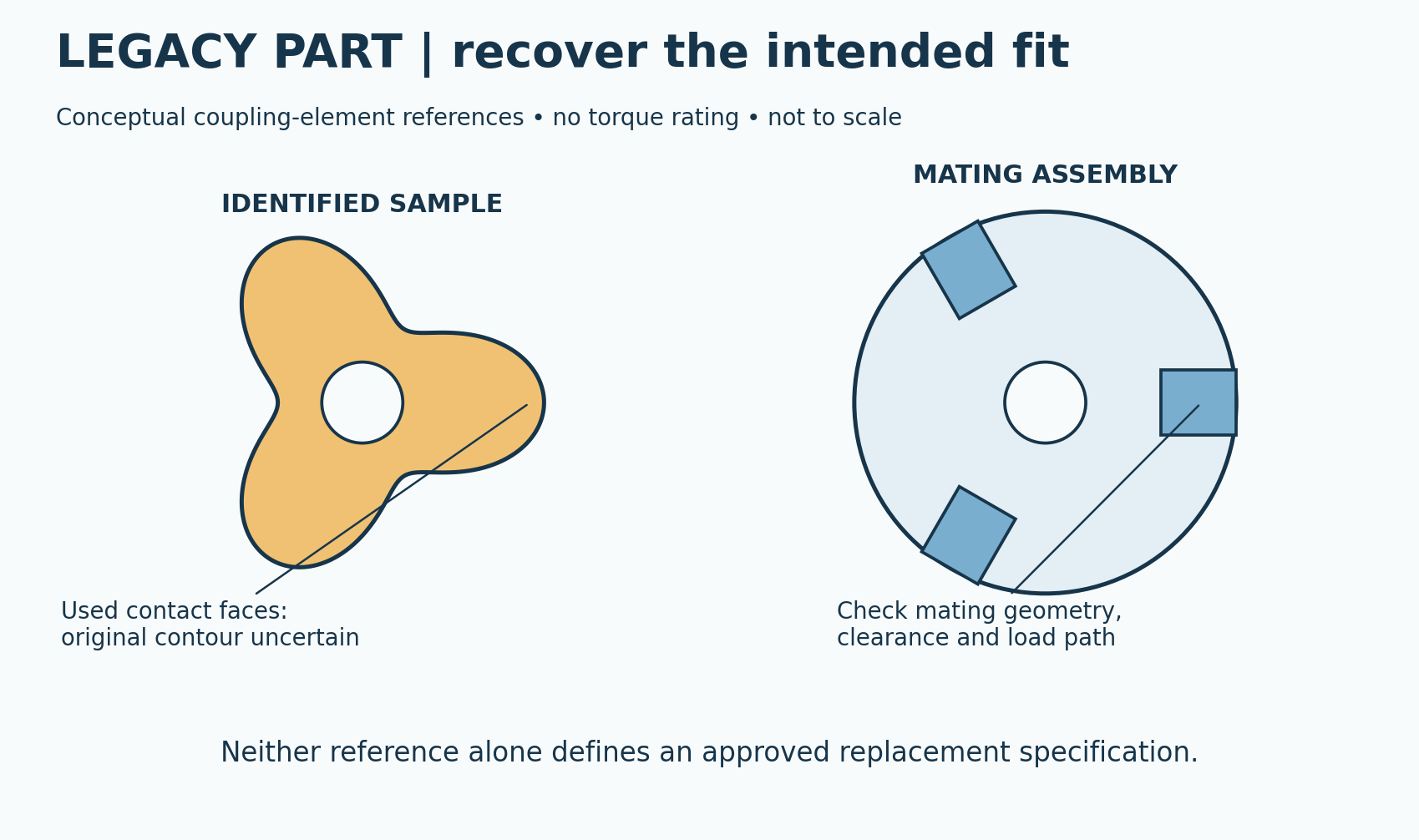
Example 1: Replacing an Obsolete Elastomeric Coupling Element
Starting point: a used lobed element is available, but its contact faces are worn and the original material designation is unknown. The assembly’s mating features provide additional evidence about the intended fit.
Sourcing response: review the complete coupling, available design information, alignment, torque duty, cycling and environment. Distinguish mating constraints from dimensions measured only on the used element. Define the required contact and deformation behavior before freezing the replacement drawing.
Approval: confirm fit, retention and the relevant loaded behavior through an agreed controlled trial. For machinery where failure has significant consequences, the responsible equipment designer should determine the qualification needed. The diagram below shows the information gap; it is not a recommended coupling design.
Example 2: Adding a Backup Source for a Replaceable Contact Strip
Starting point: an OEM has an approved strip and wants another source to reduce supply disruption. Nominal dimensions are known, but the existing approval does not clearly state allowable contact force or wear limits.
Sourcing response: document those missing requirements before asking candidates to declare equivalence. Identify the alternate material and mounting construction, then compare fit, working contact, relevant exposure and progression of wear against a common baseline.
Approval: release the alternate part under its identified configuration and agreed inspection plan. Keep initial use observable and define how a change or nonconformance will be handled. A backup source becomes useful through a completed approval, rather than through a quotation alone.
Turn the Shortlist into a Controlled Supply Arrangement
Once a candidate passes technical review, agree quotation scope, tooling responsibility, sample approval, delivery assumptions and the records needed with each shipment. Our polyurethane component procurement checklist covers these purchasing decisions in detail.
| Record | Purpose |
|---|---|
| Approved drawing and material reference | Identifies the configuration that the evidence supports. |
| Sample and trial report | Records conditions, results, limits and remaining qualification questions. |
| Manufacturing and inspection agreement | Defines relevant checks, traceability and responsibility. |
| Change and exception controls | Prevents an approved build from silently becoming another construction. |
After release, record installed exposure and replacement triggers using our polyurethane service-life and inspection guide. Review comparable observations rather than accepting a universal lifetime promise. Feed confirmed operating evidence back into the specification.
Source Custom Polyurethane Parts: Frequently Asked Questions
Q1. How do I find a suitable custom polyurethane manufacturer?
Search by process, component and duty, then screen candidates against the geometry, material, inspection and production capability your part requires.
Q2. Can a factory quote from a photograph?
A photograph may support an initial discussion. A reliable technical offer usually needs dimensions, quantity, construction and application information.
Q3. Can an old PU part be copied exactly?
A used part provides evidence, but wear and deformation may conceal the original design. Confirm functional dimensions with mating information and an authorized specification.
Q4. Does equal hardness mean the same material?
No. Hardness does not identify the formulation or establish environmental, wear and dynamic performance.
Q5. Must a second source use the original proprietary formula?
Follow the customer’s specification. Where alternatives are allowed, identify the proposed construction and qualify it against the agreed functional requirements.
Q6. How many prototypes should be ordered?
Choose the quantity from the inspection, trials, variability and consequences involved. There is no universal sample count for all components.
Q7. Does a raw-material brand prove finished-part quality?
No. Review the formulation, manufacturing controls, geometry and qualification evidence for the part that will be delivered.
Q8. What should I send Kubis Tech for a sourcing review?
Send drawings or identified samples, mating information, loads, movement, exposure, quantities and acceptance requirements. Identify whether the project is new, a legacy replacement or a second source.
Discuss Your Custom Cast PU Component with Kubis Tech
To source custom polyurethane parts, share the working function and the information already available. Include the questions still unresolved so the review can address material candidates, manufacturability and a practical qualification plan.
Send your component for a sourcing review with the drawing revision, quantities and intended equipment duty.