
Food grade polyurethane should be selected for a defined food-contact use, rather than approved by the material name alone. Equipment designers need evidence for the formulation, food type, contact conditions and finished construction, alongside checks for cleaning, wear and practical access.
This guide covers custom cast PU components for food-processing and handling equipment. It helps engineering, maintenance and purchasing teams separate food-contact documentation from mechanical performance and hygienic design, then combine them in a usable component specification.
Define the Intended Use of Food Grade Polyurethane
Map where the component sits and what can reach food. A scraper touching unpackaged product, a guide touching the outside of sealed packaging and a support beneath the machine have different exposure questions. Include foreseeable transfer routes such as splash, drips, damaged packaging and wear debris.
| Input | What to record | Why it matters |
|---|---|---|
| Product and contact | Food type, direct contact, contact area, duration and repeated use. | Defines the intended application and relevant evidence. |
| Operating conditions | Product and part temperatures, pressure, load, motion and dwell. | Connects contact assessment with component function. |
| Cleaning sequence | Cleaning agents, concentrations, temperatures, exposure times and rinsing. | Defines an additional chemical and thermal duty. |
| Construction | Formulation reference, colorants, inserts, bond system and exposed surfaces. | Identifies the finished build that needs assessment. |
| Destination and limits | Sales market, intended-use restrictions and replacement criteria. | Prevents evidence from being extended beyond its scope. |
Dry ingredients, fatty products, acidic products and aqueous foods should not be treated as equivalent exposures. A material statement for a restricted dry-food use does not automatically cover wet or fatty contact. Use our cast polyurethane material-selection guide to combine those inputs with the mechanical duty.
Food Grade Polyurethane Needs Traceable, Use-Specific Evidence
Ask for the applicable regulatory basis and a statement identifying the formulation or controlled grade, intended food types, temperature and duration limits. Review the supporting test report and its specimen identity. A raw-material letter, a finished-part report and a declaration address different parts of the evidence.
A useful report identifies what was tested, by whom, under which methods and conditions, and against which limits. Check whether it represents the offered color, formulation and manufacturing construction. A blind test can reduce identification bias, but the word “blind” does not expand the report’s technical or regulatory scope.
Keep destination-market requirements separate
For the United States, identify the food-contact regulatory route applicable to the actual composition and intended use. For example, 21 CFR 177.1680 concerns specified polyurethane resins under prescribed dry-food conditions; it is not blanket permission for every PU part. Do not assume the repeated-use rubber provisions of 21 CFR 177.2600 automatically apply to any polyurethane formulation.
For the European Union, assess the relevant requirements under Regulation (EC) No 1935/2004 and applicable manufacturing and material-specific rules. Confirm classification before applying Regulation (EU) No 10/2011: that plastics measure excludes rubber. For China, confirm the applicable food-contact material category, current GB requirements and permitted substances for the proposed construction. A US report alone does not establish EU or Chinese compliance.
UBE Urethane Systems provides background on tailoring PU systems. Supplier portfolio information does not replace the food-contact evidence for a finished component or establish that Kubis uses a particular brand.
Design the Assembly for Cleaning and Inspection
Food-contact suitability and hygienic equipment design are related but separate requirements. A material with appropriate documentation can still form an inaccessible joint or retain product in the installed assembly.
Review seams, insert boundaries, fastener recesses, exposed edges and the route by which cleaning reaches the surface. Define intended drainage and removal access. Avoid relying on an uninspectable bond line or assuming a compliant edge will always close an assembly gap.
ISO 14159 provides a machinery hygiene-design reference. Use the applicable published requirements in the equipment review; mentioning the standard does not certify the part or establish that the machine can be cleaned effectively.
Specify functional fits and contact geometry using our custom polyurethane parts design guide. Consider how deformation, assembly variation and wear can change clearances. Check whether the component can be removed without damaging a food-contact surface and whether its orientation is clear during reassembly.
Check Cleaning Resistance and Mechanical Duty Separately
Polyurethane cleaning resistance depends on the complete formulation and the actual exposure. Record the cleaning product, concentration, temperature, duration, frequency and any mechanical action. Include sanitizer and rinse stages rather than describing the duty simply as “washdown.”
Do not transfer a dry-heat result to hot water or steam. The polyurethane temperature-range guide explains why part temperature, medium and time must be considered together. There is no universal steam-cleaning or sterilization rating for cast PU.
ASTM D471 can support comparative liquid-exposure testing of suitable rubber-like materials. Agree applicability and conditions with the laboratory. It is not a food-contact migration approval, a sanitation validation or a direct service-life prediction.
Also inspect cutting, abrasion, cracks, residual deformation, swelling and the attachment. Chemical migration evidence does not establish control of physical fragments. Define when damage or wear makes the part unacceptable, and check the mating surface that may be causing local damage.
Where another elastomer may better fit the duty, use the polyurethane versus rubber comparison to frame the alternatives. Neither material family is universally more suitable for food equipment; compare identified grades against the same contact, cleaning and functional requirements.
Three Food-Equipment Design Examples
These are illustrative engineering scenarios, not customer case histories or certified equipment designs. They contain no measured performance improvement or approved contact rating.
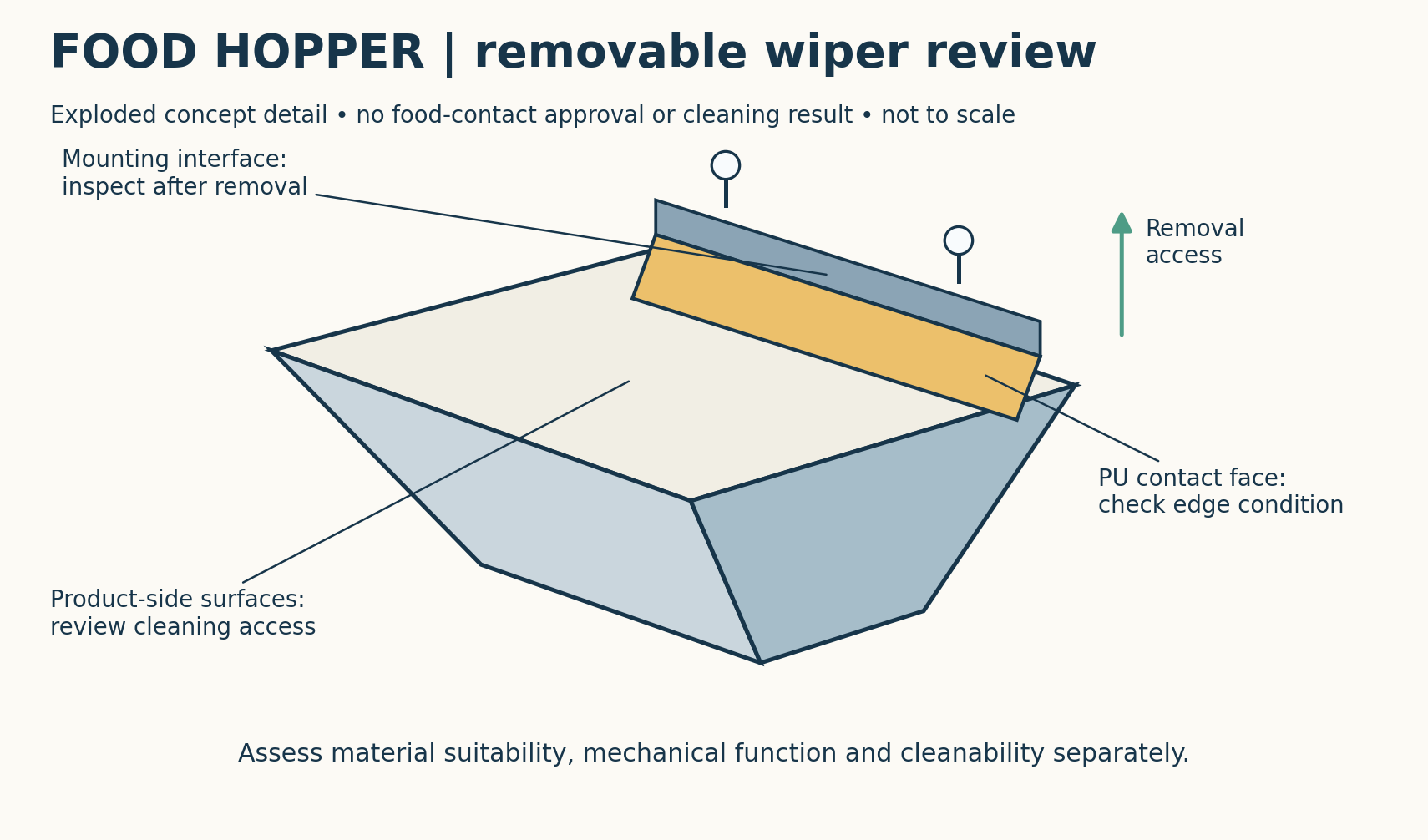
Example 1: A Removable Scraper in an Open Product Hopper
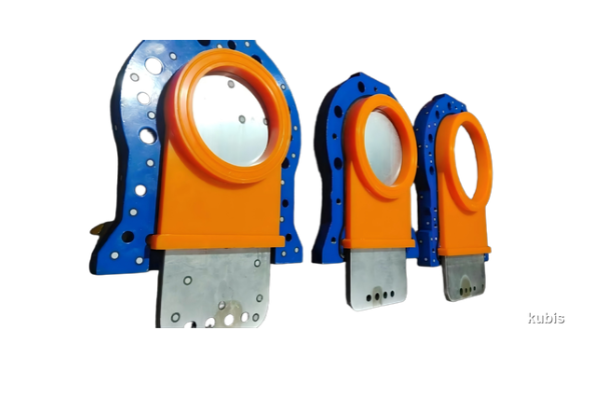
Task: maintain the required scraping contact while allowing product-contact surfaces and the mounting interface to be inspected. The duty includes the food, operating load and repeated cleaning sequence.
Design review: identify the actual contact surface, mounting arrangement, edge condition and removal procedure. Examine the joint behind the scraper for retained product. Confirm that worn geometry does not expose an insert or create a new collection pocket.
Validation: review food-contact evidence for the selected build, then test the required contact behavior and cleaning access. After representative operation and cleaning, check the working edge, interface, attachment and recovery. Agree the acceptance and replacement limits before the trial.
Example 2: A Contact Pad Handling Sealed Food Packages
Task: guide or hold a sealed package without unacceptable marking, tearing or slip. Establish whether the pad only touches packaging or whether spills, damaged packs or wear debris can create another transfer route.
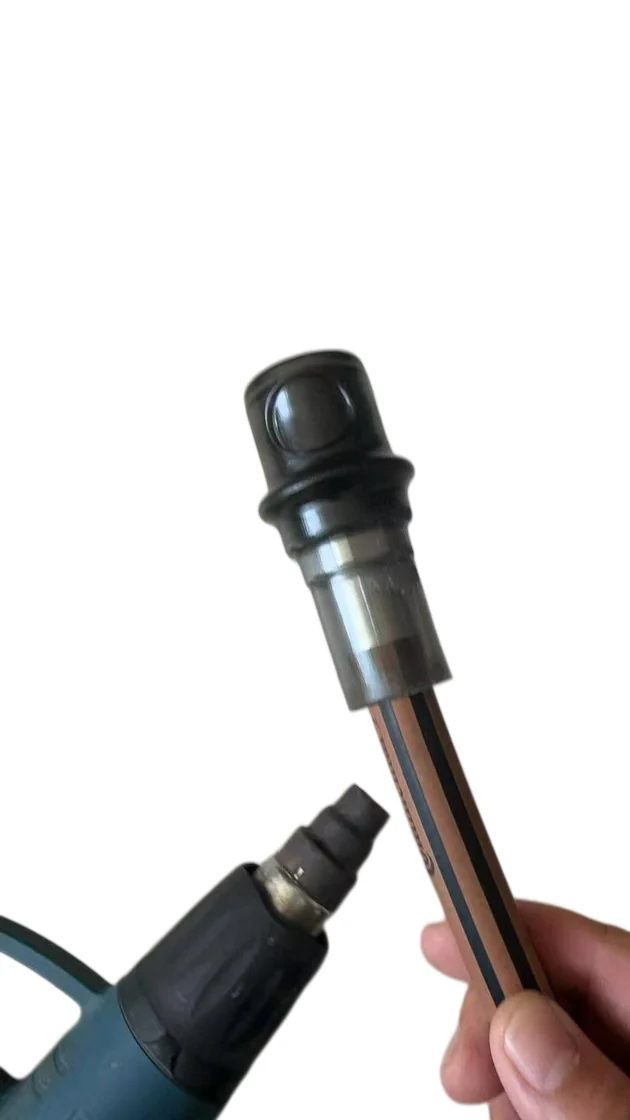
Design review: evaluate pad geometry, grip, release and package integrity under the intended load. Review cleaning separately, including residues and any change in pad surface. Color can assist identification, but it does not prove food-contact suitability, antibacterial behavior or detectability.
Validation: use representative packages and cleaning conditions. Record package damage, handling performance, surface deterioration and the inspection method. If metal or X-ray detectability is required, specify and verify it for the selected material, fragment conditions and actual detection system.
Example 3: A Custom Molded Component for Food Equipment
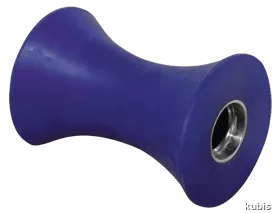
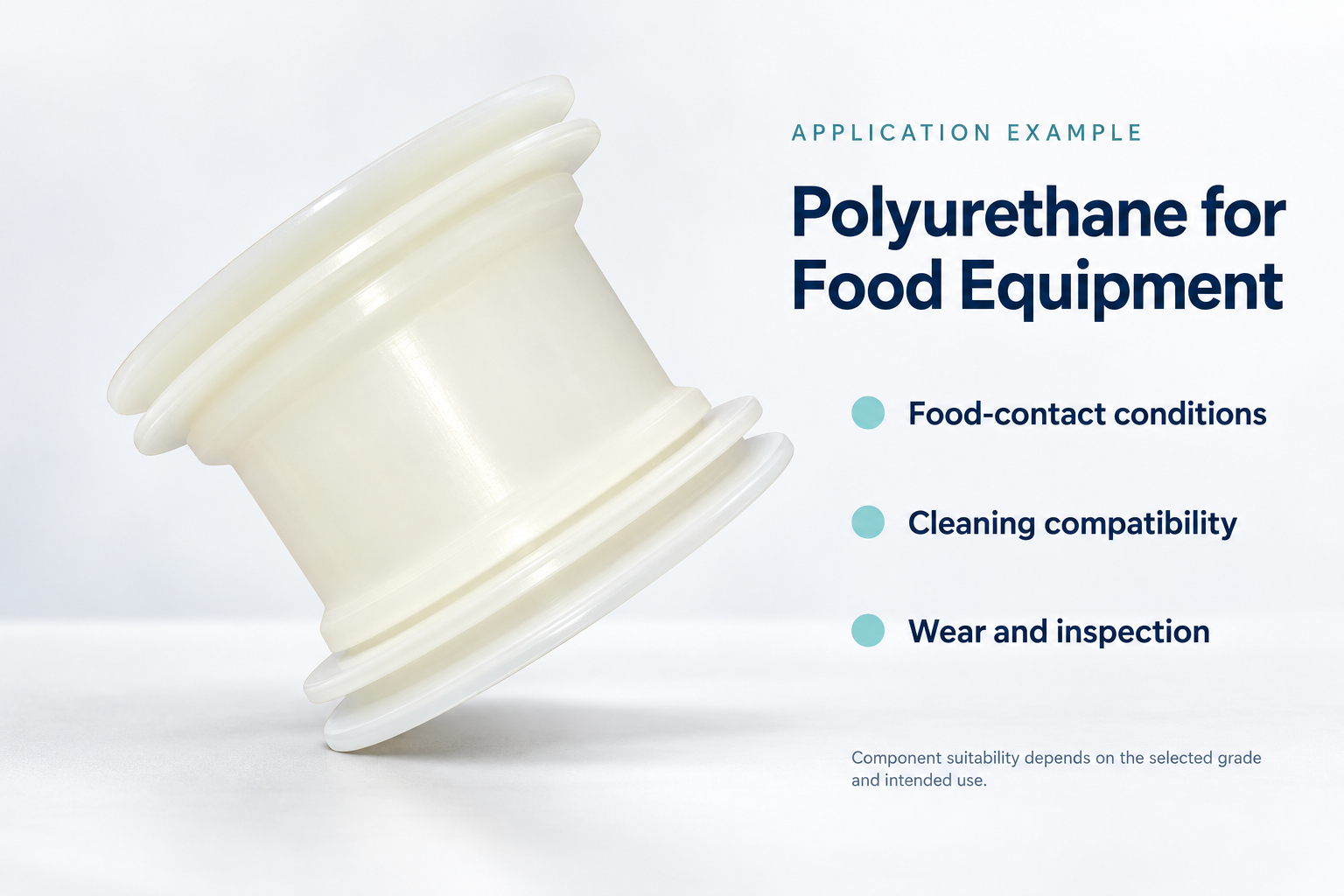
Component review: the illustrated ivory-colored part provides an example of a custom molded PU geometry. Its flanges, edges and central body should be reviewed against the actual assembly drawing. The image alone does not establish the operating function, approved food contact or permissible load.
Selection and validation: define the contact conditions, cleaning sequence, mating surfaces and required mechanical behavior. Confirm documentation for the selected formulation and inspect the edges and functional surfaces after representative operation and cleaning. Link approval to the supplied material and drawing revision.
Qualify Food Grade Polyurethane as a Finished Component
Build a qualification plan around three questions: is the food-contact use supported, does the component perform its function, and can the installed construction be cleaned and inspected as intended? One successful test does not answer all three.
| Review | Evidence to retain | Limit to recognize |
|---|---|---|
| Food-contact use | Identified grade, applicable basis, report scope and intended-use restrictions. | A result applies within its documented scope. |
| Mechanical function | Fit, contact, load, movement, wear and attachment checks. | A material specimen does not reproduce every assembly effect. |
| Cleaning and hygiene | Defined cleaning sequence, accessibility and relevant cleaning-verification results. | Appearance alone does not demonstrate hygienic cleanliness. |
| Repeat production | Drawing revision, material reference, traceability and change-review agreement. | Approval must remain linked to the supplied construction. |
The polyurethane component procurement checklist helps define documents and change responsibilities. Review formulation, pigment, processing, insert or application changes before extending previous approval to the new condition.
Plan Inspection and Replacement Before Release
| Observation | Review |
|---|---|
| Cut, crack or chipped edge | Assess function, fragment risk and progression against the approved action limit. |
| Swelling, softening or changed surface | Check exposure and cleaning history; investigate before approving continued use. |
| Loose attachment or opened interface | Review retention, product entry and the equipment’s approved response procedure. |
| Changed cleaning or product | Recheck material compatibility and the scope of the food-contact evidence. |
Use our polyurethane inspection and service-life guide to connect findings with identifiable parts and operating exposure. Food grade polyurethane does not have one universal replacement interval. Set the interval and action limits for the equipment, product and observed trend.
Food Grade Polyurethane: Frequently Asked Questions
Q1. Can polyurethane be used in direct contact with food?
A suitable formulation and finished construction may be used where the applicable food-contact requirements and intended-use conditions are supported by evidence.
Q2. Does “food grade” mean FDA approved?
The phrase alone establishes neither an approval nor a defined use. Request the applicable regulatory basis, identified material and supporting conditions.
Q3. Does a US test report establish EU or Chinese compliance?
No. Review the requirements for the destination market and the actual material classification and use.
Q4. Can food grade polyurethane withstand steam cleaning?
Confirm the specific grade, steam conditions, duration, repetitions and required retained function. A food-contact statement is not a steam-resistance rating.
Q5. Does blue polyurethane guarantee food safety or detectability?
No. Color is an identification feature. Food-contact suitability and any detection performance need separate supporting evidence.
Q6. Is migration testing enough to approve the component?
No. Review the applicable compositional requirements, mechanical function, physical-fragment risk, cleanability and supplied-build controls as well.
Q7. Can the same report cover every color and hardness?
Do not assume that it does. Confirm what the evidence represents and assess relevant formulation or construction changes.
Q8. What should be sent for an application review?
Send the drawing, food type, contact time and temperature, cleaning sequence, load, quantity, destination market and required documentation.
Discuss Food-Equipment Components with Kubis Tech
Since 2024, Kubis Tech has been developing polyurethane solutions for food-equipment applications. For a proposed food grade polyurethane component, request the available grade-specific documentation and review its scope against your intended use.
Send your food-contact and equipment requirements to Kubis Tech to discuss candidate construction, supporting evidence and a practical qualification plan.