Polyurethane operating costs depend on the complete replacement and operating burden, not only the price of a molded part. A custom design is economical when it meets the required function and reduces relevant costs over an agreed comparison period. Longer life, shorter maintenance and lower process losses are possibilities to test, rather than automatic properties of PU.
This guide helps equipment designers, maintenance teams and buyers evaluate custom cast polyurethane wear and contact components. It provides a cost boundary, a transparent calculation and the operating evidence needed before approving a change.
Compare Polyurethane Operating Costs on the Same Basis
Start with an identified assembly and a fixed period or useful output. State the required load, speed, throughput and quality. A cheaper component that changes the process or fails its acceptance criteria is not an equivalent alternative.
Define the cost boundary before collecting numbers. Include relevant differences between alternatives, and identify exclusions. For a longer analysis, agree on the treatment of inflation, discounting and residual value with the responsible finance team.
IEC 60300-3-3 provides general life-cycle costing guidance, including costs associated with dependability. It is useful background for structuring a review; it does not certify a supplier’s saving or prescribe the simplified example below.
| Cost item | Record | Avoid |
|---|---|---|
| Parts and delivery | Quantity per event, unit price, freight and applicable consumables. | Comparing a complete assembly price with a cover-only price. |
| Replacement work | Labor hours, access, handling, installation and commissioning. | Counting only the time spent physically fitting the new part. |
| Attributable downtime | Actual production interruption and an agreed loss rate. | Counting the whole shutdown when this task does not extend it. |
| Development and approval | Drawing changes, tooling, prototypes and validation. | Ignoring one-time costs or charging them repeatedly without explanation. |
| Process and support effects | Measured quality losses, energy differences, inventory and end-of-life costs where relevant. | Assuming improvements without evidence or counting the same loss twice. |
Build a Simple Model Before Specifying a Premium Grade
A practical review of polyurethane operating costs can begin with the following period-cost model:
Evaluated period cost = one-time change cost + the sum of replacement-event costs + other relevant operating and support differences.
Replacement-event cost = parts + replacement work + attributable downtime loss.
Use actual or explicitly assumed event counts. Count initial installation separately where it differs, and use the same start and end conditions. Cost per operating hour, tonne or acceptable finished unit is useful only when both alternatives deliver comparable service and the denominator is clearly defined.
Use a finance-approved measure for downtime loss. Gross sales per hour are not automatically the loss from a stoppage, and production recovered later may change the estimate. If the rate already includes labor, quality losses or other charges, do not add those items again.
For the technical specification, start with the cast polyurethane material-selection checklist. Request the properties needed for the failure mechanism instead of automatically choosing the highest-priced formulation.
Worked Example: A Higher Part Price Can Still Lose or Win
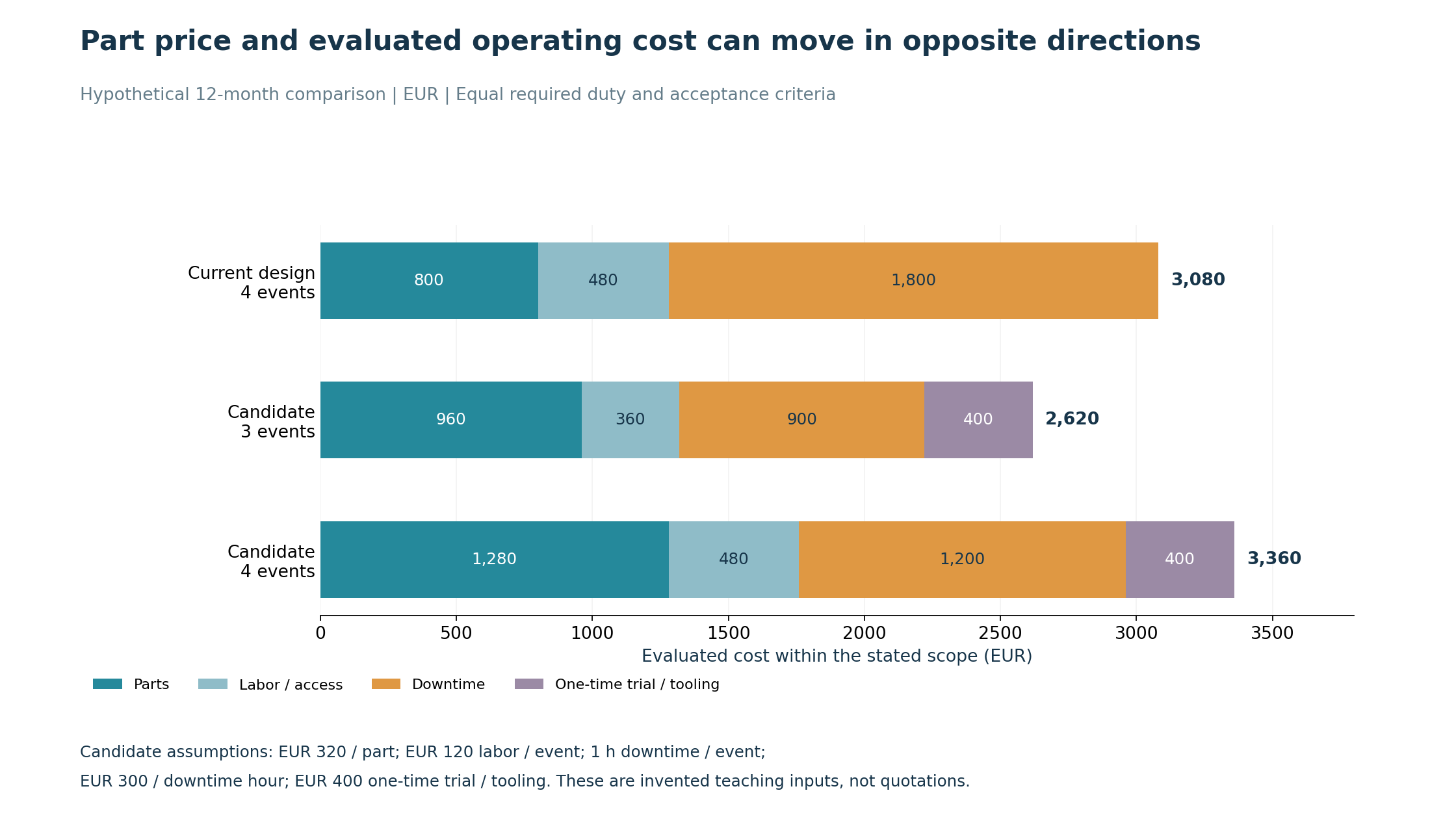
All values in this example are invented teaching assumptions, not a quotation or customer result. Compare the same required duty over 12 months. Initial installed costs are assumed equal and excluded. The example covers replacement parts, work, attributable downtime and a candidate trial/tooling allowance; other differences are assumed zero.
| Input or result | Current design | Candidate assumption |
|---|---|---|
| Replacement events within the window | 4 | 3 |
| Parts per event | 200 | 320 |
| Labor and access per event | 120 | 120 |
| Attributable downtime per event | 1.5 hours | 1.0 hour |
| Downtime loss rate, excluding labor charged above | 300 per hour | 300 per hour |
| One-time trial/tooling cost in this window | 0 | 400 |
| Evaluated cost | 4 × (200 + 120 + 1.5 × 300) = 3,080 | 400 + 3 × (320 + 120 + 1.0 × 300) = 2,620 |
The candidate costs EUR 460 less within these assumptions. Its annual replacement-parts bill is actually higher: EUR 960 rather than EUR 800. The result depends on fewer events and less attributable downtime, with the one-time allowance included.
Test the assumptions that make the saving possible
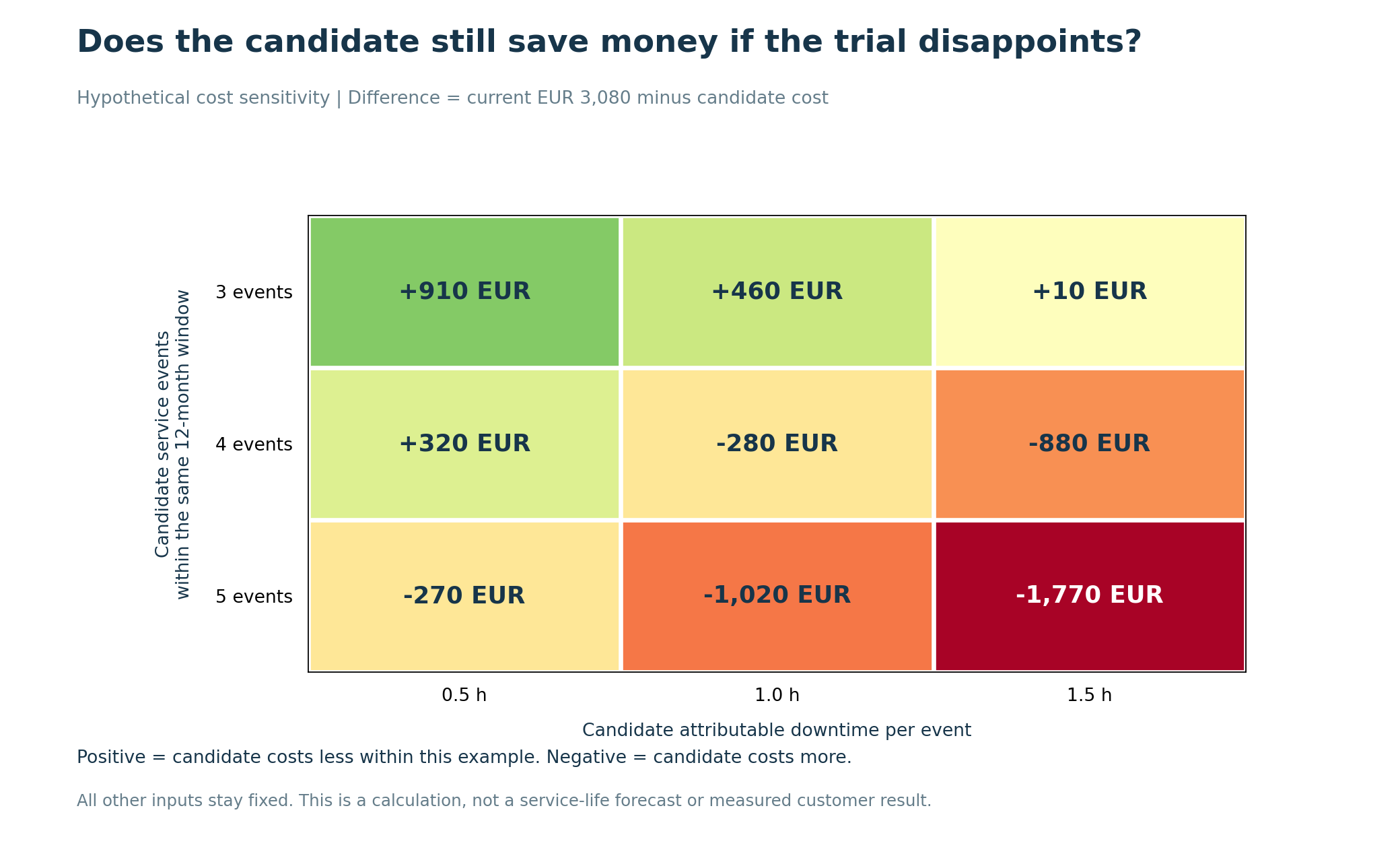
If the candidate still needs four events, its evaluated cost becomes EUR 3,360, or EUR 280 more than the current design. If downtime loss is set to zero while the three-event assumption remains, the current cost is EUR 1,280 and the candidate cost is EUR 1,720.
Polyurethane operating costs should therefore be evaluated under conservative as well as expected assumptions. Add any real difference in initial conversion, scrap, energy or support cost before deciding.
Where Custom Design May Reduce the Maintenance Burden
Define the required function before pursuing savings. Check temperature and media constraints using the polyurethane temperature-range guide. Compare an all-metal part, a replaceable PU working layer and a hybrid construction through the polyurethane-versus-metal design guide where appropriate.
1. Replace a local wear zone instead of the entire lining
Design question: can panel boundaries isolate the observed wear without creating an exposed leading edge or an obstruction? Cost evidence: record panel quantities, inspection time, access, handling and actual shutdown extension. Acceptance: the shell remains protected and flow remains usable. See wear-liner selection and maintenance for related inspection questions.
2. Evaluate cover renewal while preserving a serviceable core
Design question: is a metal core suitable for another service interval after inspection and preparation? Cost evidence: include stripping, core repair, transport, processing, finishing and spare assemblies needed during turnaround. Acceptance: the renewed assembly meets its fit, load and contact requirements. The wheel delamination guide identifies related interface issues; core reuse is not automatic.
3. Pay for the formulation and tolerances the function requires
Design question: which dimensions and material responses control the process? Cost evidence: separate essential machining and qualification from optional features. Acceptance: the part retains its working function and manufacturing repeatability. Relaxing a noncritical feature may help, but weakening a functional requirement is not a cost-saving method.
UBE Urethane Systems describes application-dependent formulation options. Such supplier background can inform candidate screening; it does not establish the lifetime or economic benefit of a finished Kubis component.
Validate Polyurethane Operating Costs with a Controlled Trial
Keep a baseline and identify the candidate batch, geometry and installation. Agree on protective and process acceptance limits before installation. Compare similar locations and operating exposure, and record changes in feed, load, speed, cleaning or temperature.
| Record | Why it matters | Review point |
|---|---|---|
| Hours, tonnes, cycles or accepted output | Connects observed cost with useful service. | Were both alternatives exposed to comparable duty? |
| Condition and replacement trigger | Distinguishes a planned change from a functional failure. | Was the same acceptance rule applied? |
| Work and production interruption | Separates technician effort from attributable line stoppage. | Did the change extend the shutdown? |
| Quality, energy and collateral damage | Captures consequential differences where measured. | Is the claimed effect supported and counted only once? |
| Batch and operating changes | Makes the trial traceable and repeatable. | What needs revalidation before wider release? |
An unfinished trial is not a measured service life: record that a part is still operating at its last observation. Do not infer a precise replacement interval from that observation alone. The guide to custom PU parts that underperform in service discusses the gap between drawing compliance and functional approval.
Laboratory wear data can help screen candidates. For example, ASTM D5963 is a rotary-drum abrasion reference for suitable elastomer specimens. Confirm applicability with the laboratory; do not convert its result directly into a service-life multiplier or a cost-saving percentage.
Polyurethane Operating Costs: Frequently Asked Questions
Q1. Are custom polyurethane parts always cheaper to operate?
No. The answer depends on functional suitability, event frequency, replacement effort and the included costs. A higher-priced part needs evidence that the relevant benefits justify its additional cost.
Q2. Is the lowest unit price the best procurement choice?
Not necessarily. Compare equivalent assemblies and useful service, including relevant maintenance and change costs. Keep assumptions visible so a low price is not offset by an overlooked burden.
Q3. How should downtime be valued?
Use an agreed loss rate applied to the production interruption attributable to the task. Account for recoverable production and avoid duplicating costs already included in that rate.
Q4. Should tooling and prototype costs be included?
Include the relevant one-time costs within the agreed evaluation window. Explain any allocation over quantities or future periods rather than hiding development cost in an unspecified saving.
Q5. Does better abrasion performance prove lower operating cost?
No. Attachment, deformation, temperature, process quality and replacement work can determine the outcome even when a material performs well in an abrasion test.
Q6. Can every metal core be reused?
No. Inspect the structure, fits, damage and suitability for the proposed renewal process. Include preparation and turnaround costs before comparing renewal with replacement.
Q7. What if the trial part has not yet worn out?
Report its observed exposure and current condition. Treat its final replacement interval as unknown, and use explicit scenarios instead of reporting an unmeasured lifetime.
Q8. What evidence should support a saving claim?
State the baseline, candidate, operating exposure, acceptance criteria, cost boundary, event records and calculation. Identify estimates and exclusions separately from measured results.
Request a Design and Cost Review
Send the current drawing, failure photographs, material, operating conditions, replacement records and access constraints. Add part quantities, work time, attributable stoppage and the process function that must be protected.
Contact Kubis Tech to review your component and identify candidate design changes, a practical trial and the information needed to compare polyurethane operating costs.