
The polyurethane temperature range for an industrial part must be qualified for its formulation, exposure time, environment and working load. A catalogue minimum and maximum can help screen a candidate, but they do not establish how a loaded component will behave during a cold start, prolonged operation or a hot cleaning cycle.
For equipment designers, a useful specification states what the part must still do at temperature: retain clearance, recover after compression, grip a workpiece, resist damage or remain attached to its support. This guide focuses on cast polyurethane elastomers and the evidence needed to approve them.
What Does a Polyurethane Temperature Range Actually Mean?
Ask which condition produced the quoted range and which function was checked. A specimen remaining intact after heating is different evidence from a component meeting a displacement limit while hot and loaded.
| Claim | Ask for | What it does not establish alone |
|---|---|---|
| Continuous service temperature | Identified formulation, duration, medium, load and retained-property or functional criteria. | Suitability for every part geometry or an unspecified lifetime. |
| Short-term peak temperature | Peak duration, frequency, number of events and recovery conditions. | Approval for repeated peaks or continuous operation. |
| Low-temperature result | Test method, conditioning time, specimen and measured response. | Usable flexibility, grip or sealing at that temperature. |
| Cure or post-cure temperature | The manufacturing process and finished-material data. | A continuous service rating for the cured part. |
| Raw-material melting point | Which raw material was measured and its relevance to the cured system. | The operating limit of the finished cast elastomer. |
Cast thermoset PU and melt-processable TPU should also be distinguished. Review cast polyurethane versus TPU when interpreting a datasheet from a different manufacturing route. A discussion of melting is not a substitute for functional testing.
Specify the Polyurethane Temperature Range as an Operating History
Record the minimum start condition, normal operation, local peaks and shutdown or cleaning exposure. Use part-temperature measurements where practical. Friction and repeated deformation can make the component warmer than the surrounding air, while a thick assembly may take time to cool or warm through.
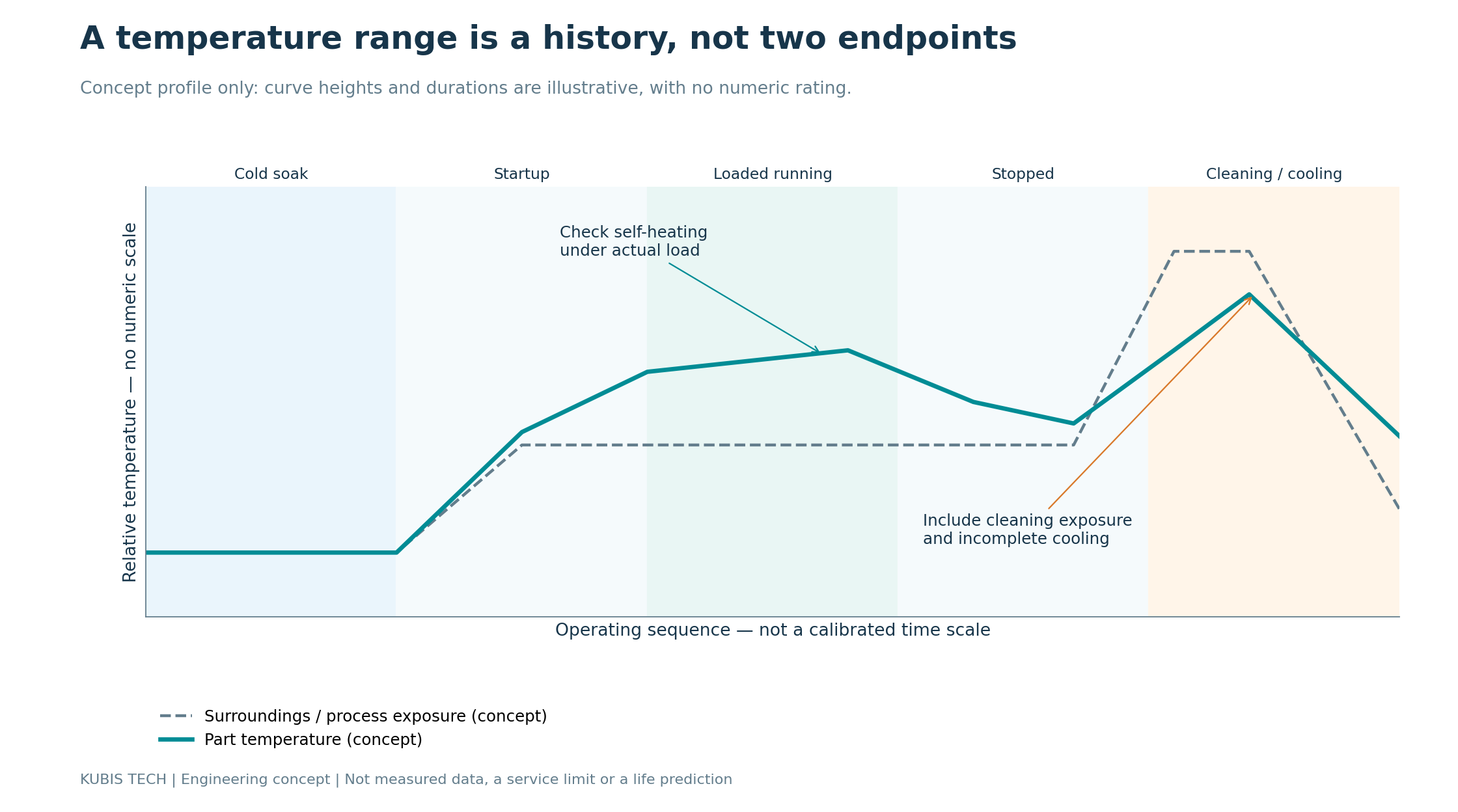
| Input | Record | Design question |
|---|---|---|
| Temperature and time | Cold soak, normal part temperature, peaks, dwell and cooling intervals. | Does the test represent the complete exposure history? |
| Medium | Dry air, liquid identity, concentration, steam conditions or cleaning sequence. | Is the evidence for the medium the part will actually contact? |
| Mechanical state | Load, compression, sliding, cycling, speed and shutdown loading. | Are movement and damage acceptable during exposure? |
| Construction | Thickness, restraint, critical fits, metal inserts and attachment. | Can thermal movement or local stress compromise the assembly? |
| Acceptance | Allowable deformation, wear, loss of function and inspection interval. | What measurable change requires replacement? |
Use our cast polyurethane material-selection checklist to combine these thermal inputs with the rest of the component specification.
Hot Operation and Cold Starts Need Different Checks
At elevated temperature: check loaded function and recovery
Measure the response that matters while the part is at its operating temperature. Then assess dimensions and properties after an agreed recovery period. A part may look satisfactory after cooling while having allowed too much movement during service.
Distinguish creep under sustained load from residual deformation after unloading. Neither is fully described by room-temperature hardness. Repeated loading also requires attention to internally generated heat, fatigue and the available cooling path.
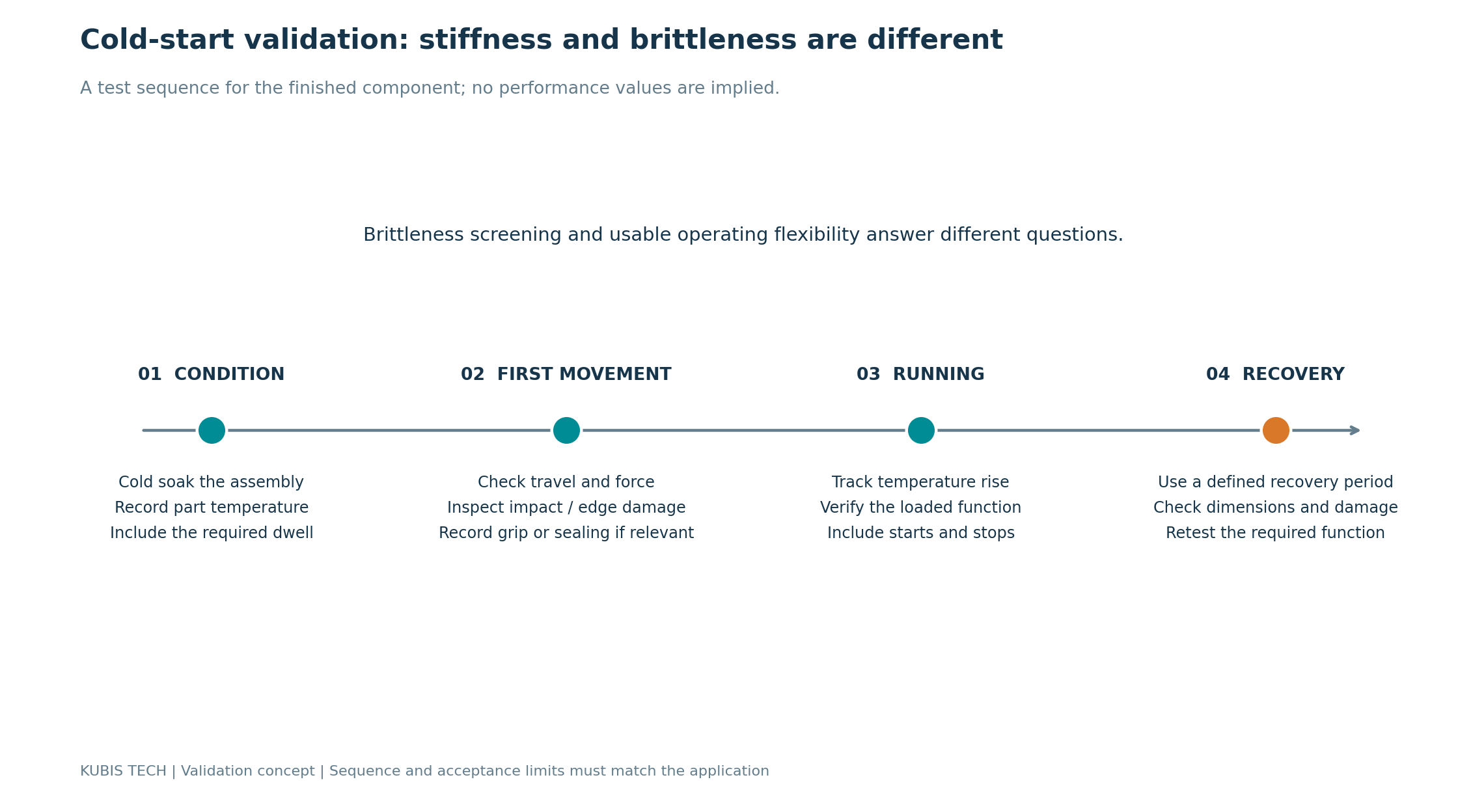
At low temperature: check first movement, not only fracture
A material can avoid cracking in a specified test yet be too stiff for the required stroke or contact behavior. Condition the assembly for the relevant dwell and evaluate the first actuation, then check the transition into normal operation.
The cold-climate polyurethane guide addresses related operating questions. For a defensible polyurethane temperature range, retain the distinction between a laboratory brittleness result and a component’s minimum usable temperature.
Dry Heat, Hot Water and Steam Are Separate Exposure Conditions
Do not transfer a dry-air result directly to hot water or steam. State the liquid or vapor conditions, exposure duration, pressure where relevant, cleaning chemicals and whether the part is loaded. Include transitions between media if the machine alternates between production and cleaning.
Polyether, polyester and PCL-based names can help identify candidate systems, but they do not assign the polyurethane temperature range. Compare complete formulations using the relevant wet, oil-contact and mechanical evidence. UBE Urethane Systems describes the scope for tailoring cast elastomer formulations; its overview is background rather than a temperature guarantee for a Kubis component.
Three Design Scenarios: Turn Temperature into an Acceptance Check
These scenarios explain engineering decisions. They are not customer case histories and contain no measured service-life improvement.
1. Continuous operation followed by hot cleaning
Requirement: retain the working dimensions through production and repeated cleaning. Review: write separate production, cleaning and recovery conditions rather than choosing the highest temperature alone. Validation: reproduce the relevant sequence and check dimensions, surface condition and the required function at the appropriate stages. Do not assume that cooling between events reverses all changes.
2. A dynamic component runs hotter than the workshop
Requirement: maintain contact behavior during extended operation. Review: measure accessible part temperatures and document the measurement limitations; review loading, cycling and heat removal. Validation: monitor temperature and function together, including starts, stops and dwell periods. For covered components, inspect the interface using the questions in our wheel delamination guide.
3. Equipment restarts after a cold overnight dwell
Requirement: complete the first movement within the permitted force and travel. Review: define cold conditioning of the assembly and its first loading event. Validation: check startup response, damage and subsequent operation before judging the component from a warmed-up trial. For a buffer or mount, the vibration-damper selection guide adds the relevant dynamic requirements.
Which Tests Support a Polyurethane Temperature Range?
Select material tests with the laboratory, then add the finished-component checks. Confirm that each method suits the formulation, hardness, specimen and question. Standards provide methods; they do not assign one universal passing temperature.
| Question | Official reference | Additional evidence needed |
|---|---|---|
| How do selected properties change after hot-air exposure? | ASTM D573: deterioration in an air oven | It does not reproduce steam or automatically predict the service interval. |
| How does a specimen recover after sustained compression? | ASTM D395: compression set | Specify the applicable method and conditions. Add dynamic testing where cycling governs. |
| How does low temperature change relative stiffness? | ASTM D1053: low-temperature stiffening | Relate comparative specimen results to the permitted assembly force and movement. |
| Does a specimen fracture under the specified cold-impact conditions? | ASTM D2137: brittleness point | The result does not necessarily define the lowest usable service temperature. |
For production approval, document the actual formulation and cure history, baseline measurements, exposure sequence, test timing and acceptance limits. Use representative controls and repeat measurements where variability matters. A brief successful trial can support a screening decision; a life prediction needs a justified relationship to the relevant aging and failure mechanisms.
When comparing alternative elastomers, use the same operating requirements and acceptance method. Our polyurethane-versus-rubber guide discusses that broader selection. A different material family may be appropriate if the proposed PU cannot meet the required thermal duty.
Polyurethane Temperature Range: Frequently Asked Questions
Q1. What is the operating temperature range of cast polyurethane?
Use the range qualified for the selected formulation and component duty. Ask for the medium, duration, loading and acceptance criteria behind the supplier’s figures before approving the design.
Q2. Can polyurethane operate at 100°C?
That temperature alone is insufficient to decide. Define the duration, medium, load, cycle history and required retained function, then evaluate the proposed formulation and assembly.
Q3. Can a dry-air test qualify polyurethane for steam at the same temperature?
No. Steam exposure requires relevant evidence, including its actual conditions and repeated cleaning or process cycles where applicable.
Q4. Is the brittleness point the minimum operating temperature?
Not necessarily. The part may need useful flexibility, recovery or contact behavior beyond simply avoiding fracture in a specified impact test.
Q5. Does a higher post-cure temperature prove a higher service limit?
No. A controlled manufacturing step does not establish retained function under prolonged operating load, media exposure or repeated thermal cycling.
Q6. Is harder polyurethane more heat resistant?
Hardness alone does not establish the polyurethane temperature range. Compare the full formulation, temperature-dependent response and installed function.
Q7. Can a brief hot test establish several years of life?
No. A short test does not establish that interval without a justified aging model and evidence relevant to the actual failure mechanism.
Q8. What should be measured during a temperature trial?
Record part temperature and the required working function during the relevant stages, then inspect dimensions, damage and recovery under agreed conditions. Include attachment where the part has inserts or a bonded layer.
Request a Thermal Duty Review
Send the drawing, candidate or current material, cold-start condition, normal and peak part temperatures, time at each condition, media, loads and operating sequence. Include allowable deformation, critical fits, failure photographs and the required replacement trigger.
Contact Kubis Tech about your polyurethane temperature range requirements to discuss formulation screening, prototype construction and an application-specific validation plan.
